A great finish to a great year!
Year six have done amazingly this term. They have made heaps and heaps of progress already and we are so proud of them and the wonderful humans they are growing into. Staff are looking forward to starting our SATS booster groups in the new year. Please ensure your child knows the day, time and member of staff they are going to be taught by. We hope you have a wonderful Christmas with your friends and family and look forward to welcoming you all back in the New Year.
The Year Six Team
English
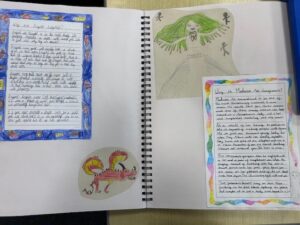
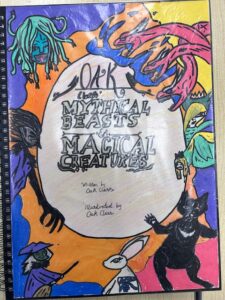
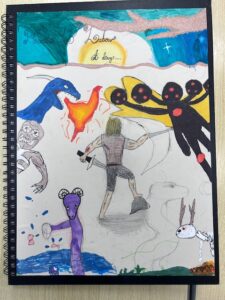
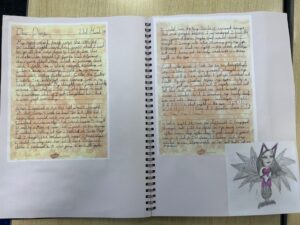
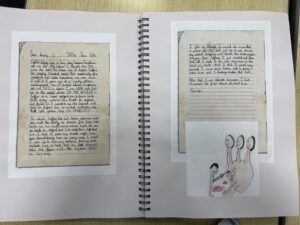
What an exciting term it has been for our budding authors! The children
have been truly busy bees, producing a delightful variety of texts, including
explanation texts, diary recounts, suspense stories, and some wonderfully
imaginative poetry. They’ve relished the opportunity to write for different
audiences and purposes, cultivating a real community of young writers.
We’ve taken a deep dive into the writing process, exploring an assortment
of texts, including some brilliant pieces from last year’s Year Sixes. It’s
remarkable to see how inspired and motivated the children have become,
crafting captivating and engaging narratives with an impressive range of
exciting vocabulary.
In our Author’s Chair sessions, they’ve enjoyed sharing their work and have
developed into experts at giving and receiving constructive feedback. Plus,
they’re building on their prior knowledge, exploring advanced punctuation
techniques that elevate their writing even further! To top it all off, we
celebrated with a pizza, publishing, and popcorn party! What a hoot! Here’s
to more exciting writing adventures ahead!
Reading
This term has been a thrilling journey through the world of reading
comprehension! We kicked things off with the inspiring tale of Mama Miti,
where the children explored the challenges faced by a Kenyan community
and the remarkable efforts of Wangari Maathai. This engaging narrative
sparked rich discussions about resilience and innovation.
Moving on, we dived into a fascinating non-fiction text about the Olympic
Games, which complemented our History topic on Ancient Greece
brilliantly. The students honed their skills in distinguishing between fiction
and non-fiction, learned how to summarise key parts of a text, and
identified various layout features such as sub-headings, captions, and
highlighted text.
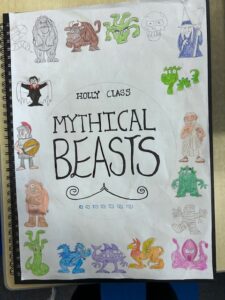
We concluded our term with a whimsical foray into poetry, starting with the
delightful Jabberwocky. The children absolutely loved it, and we're excited to
continue our poetic exploration next term! What a fantastic reading
journey it has been!
MATHS
In maths this term we have been looking at fractions, how to convert different measures and ratio.
During our unit on fractions we have looked at equivalent fractions and how to simplfy fractions using common factors. They have learnt that when the numerator and
denominator have no common factors greater than 1, the
fraction is in its simplest form. Children have been encouraged to look for the greatest possible number to divide by, but also understand that simplification
can be performed in more than one step. The children have been taught to compare fractions on a number line. They first work with pairs of fractions where one denominator
is a multiple of the other, building on learning from Year 5. They then look at pairs of fractions where the denominators are not multiples of each other, using their knowledge of
multiples and common multiples. They have learnt to add and subtract fractions – starting with fractions of the same denominator. We have then moved on to adding and subtracting using equivalent fractions and mixed number fractions.
We have worked hard to understand how to multiply fractions by integers which is the same as repeated addition of a fraction. As when adding and subtracting fractions, the denominator does not change. When multiplying mixed numbers, children can either partition them into wholes and parts, multiplying each of them by the integer, or convert the mixed
number to an improper fraction and then multiply the numerator by the integer. They have learnt to divide fractions where the numerator is a multiple of the integer they are
dividing by, for example 3/5 divided by 3, or 6/7 divided by 2.
We have learnt how to convert measures. The children can recognise, read and write all metric measures for length, mass and capacity. This is the first time they have been introduced to tonnes as a measure for mass. They can convert between units both ways, for example from metres to centimetres and centimetres to metres. When comparing measurements with different units, they know how to convert them to the
Science
In Year 6 science, students embark on an enlightening journey into the realms of light and classification, two fundamental topics that lay the groundwork for understanding the natural world.
Light is a crucial element of our daily experiences, and understanding how we perceive it is essential. Students learn about visible light, which constitutes only a small portion of the electromagnetic spectrum. This spectrum displays a range of wavelengths, each corresponding to different colours visible to the human eye. The study of light elucidates the intricate functioning of the human eye, including its various parts—such as the cornea, lens, retina, and optic nerve—that collaborate to process visual information. Furthermore, principles of reflection and refraction are explored, illustrating how light behaves when it encounters different surfaces or mediums. This understanding also extends to real-world implications, such as light pollution, which poses a significant threat to both human health and ecological balance, detracting from our night sky and impacting nocturnal wildlife.
Equally important is the scientific principle of classification, which aids students in organising the natural world around them. Classification is the method of sorting and categorising living organisms based on shared characteristics, which provides clarity and facilitates communication within scientific disciplines. In the context of animals, students concentrate on two broad groups: vertebrates and invertebrates. Vertebrates are characterised by their backbone and are further divided into categories such as mammals, birds, reptiles, amphibians, and fish. In contrast, invertebrates lack a backbone and encompass a diverse range of organisms, including insects, arachnids, molluscs, and annelids.
By engaging with these concepts, Year 6 students cultivate a deeper appreciation for the complexity of life and the fundamental principles of physics, fostering both curiosity and critical thinking in the process.
Topic
Our topic this half term has been all about The Ancient Greeks. We kick started this
unit with an exciting Ancient Greek day. We have been learning all about Ancient
Greek life, their governments, their influence and their impact on the modern day. In
line with this, we have been studying Greek art. We have investigated the three
different periods covered in this time: The Archaic period; The Classical period and the
Hellenistic period. We talked in detail about the differences between the eras, our likes
and dislikes and what influenced the changes during this time.
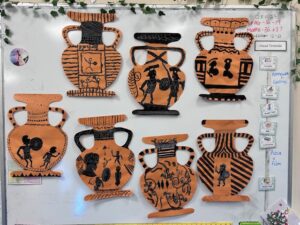
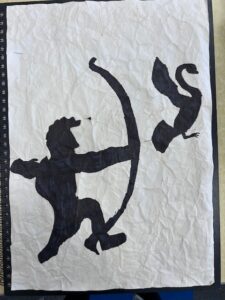
We did an art appreciation lesson about Phidias, the Greek sculptor, and evaluated his work. We have improved our drawing skills and focused on figurative drawing using sketches to plan and improve our final drawings, working on using correct proportions by sectioning the body and adding detail to finish the drawings off.
We have investigated Greek pottery and designed our own Greek pots inspired by our life story, the labours of Heracles or the Olympic games.