Wigmore Primary School Logo

Wigmore Primary School

  • [email protected]
  • 01582 616101
  • About us
    • Headteacher’s Welcome
    • Staff list
    • Pupil premium
    • Aims, Vision and Values
    • Online Safety Updates
    • OFSTED
    • Performance
    • School Prospectus
    • Key policies
    • Safeguarding
    • Contact us
    • Vacancies
    • Governors
  • Parents Information
    • Curriculum letters
    • Friends of Wigmore
    • School Calendar
    • Inclusion
    • Term Dates and Events
    • Admissions
    • Letters
    • School Uniform
    • Phonics Resources for Parents
    • School Meals
      • Free School Meals
      • Milk & Fruit
      • School Meals Menus
  • Quality of Education
    • Year Group Overviews
    • English
      • Writing
      • Reading
    • Maths
    • Science
    • Phonics: RWI
    • EYFS
    • PE and Sports Premium
    • Computing
    • French
    • RE
    • PSHE
      • Jigsaw
      • Smart School Council
    • Design and Technology
    • History
    • Geography
    • Art
    • Music
  • School Blogs
    • EYFS Blog
    • Year 1 Blog
    • Year 2 Blog
    • Year 3 Blog
    • Year 4 Blog
    • Year 5 Blog
    • Year 6 Blog
    • Headteacher’s Blog
    • PE Blog
    • Digital leaders
Wigmore Primary School Logo
  • About us
    • Headteacher’s Welcome
    • Staff list
    • Pupil premium
    • Aims, Vision and Values
    • Online Safety Updates
    • OFSTED
    • Performance
    • School Prospectus
    • Key policies
    • Safeguarding
    • Contact us
    • Vacancies
    • Governors
  • Parents Information
    • Curriculum letters
    • Friends of Wigmore
    • School Calendar
    • Inclusion
    • Term Dates and Events
    • Admissions
    • Letters
    • School Uniform
    • Phonics Resources for Parents
    • School Meals
      • Free School Meals
      • Milk & Fruit
      • School Meals Menus
  • Quality of Education
    • Year Group Overviews
    • English
      • Writing
      • Reading
    • Maths
    • Science
    • Phonics: RWI
    • EYFS
    • PE and Sports Premium
    • Computing
    • French
    • RE
    • PSHE
      • Jigsaw
      • Smart School Council
    • Design and Technology
    • History
    • Geography
    • Art
    • Music
  • School Blogs
    • EYFS Blog
    • Year 1 Blog
    • Year 2 Blog
    • Year 3 Blog
    • Year 4 Blog
    • Year 5 Blog
    • Year 6 Blog
    • Headteacher’s Blog
    • PE Blog
    • Digital leaders
Wigmore Primary School Logo
  • About us
    • Headteacher’s Welcome
    • Staff list
    • Pupil premium
    • Aims, Vision and Values
    • Online Safety Updates
    • OFSTED
    • Performance
    • School Prospectus
    • Key policies
    • Safeguarding
    • Contact us
    • Vacancies
    • Governors
  • Parents Information
    • Curriculum letters
    • Friends of Wigmore
    • School Calendar
    • Inclusion
    • Term Dates and Events
    • Admissions
    • Letters
    • School Uniform
    • Phonics Resources for Parents
    • School Meals
      • Free School Meals
      • Milk & Fruit
      • School Meals Menus
  • Quality of Education
    • Year Group Overviews
    • English
      • Writing
      • Reading
    • Maths
    • Science
    • Phonics: RWI
    • EYFS
    • PE and Sports Premium
    • Computing
    • French
    • RE
    • PSHE
      • Jigsaw
      • Smart School Council
    • Design and Technology
    • History
    • Geography
    • Art
    • Music
  • School Blogs
    • EYFS Blog
    • Year 1 Blog
    • Year 2 Blog
    • Year 3 Blog
    • Year 4 Blog
    • Year 5 Blog
    • Year 6 Blog
    • Headteacher’s Blog
    • PE Blog
    • Digital leaders
  • [email protected]
  • 01582 616101
Author Archives Sabreen Parkar

Year 6 Spring blog

7th February 2025Sabreen Parkar

Welcome to Year 6’s third blog post of the year! What a busy half term it’s been, especially with the start of our SATS boosters. We’re absolutely delighted to see so many children turning up regularly—thank you all for your fantastic support! The children have been working exceptionally hard, both in class and during their before and after school sessions. We couldn’t be prouder of their dedication and progress across all subjects. Now, it’s time for a well-deserved break! We hope everyone enjoys the half term and comes back refreshed and ready for the next challenges ahead.

ENGLISH

Reading

In our reading comprehension lessons, we’ve been diving into the thrilling world of Stormbreaker by Anthony Horowitz. Over the past few weeks, we’ve followed the journey of fourteen-year-old Alex, who gets recruited by MI6 in quite an unexpected twist. Equipped with some fantastic secret gadgets, he’s on a mission to investigate Herod Sayle, a rather mysterious figure who’s offering brand-new Stormbreaker computers to every school in the country.
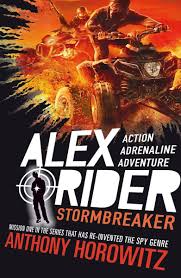
 

We’ve really enjoyed exploring Alex’s character and examining the intriguing personalities of others throughout the story. Making comparisons with other books we’ve read has sparked some lively discussions! Our inference skills were put to the test as we delved into the narrative, questioning the author’s choice of language. We even tackled some tier two vocabulary, and it’s been great to see everyone trying to use these words in their own writing. Our teachers have loved listening to our fluent and expressive reading – it’s truly been engaging!

Writing

Our Creative Writing Adventure!

This term in English, we dove into the fascinating world of flashbacks in our stories. To be honest, it was quite tricky trying to keep our readers hooked while making sure they knew exactly when a flashback kicked off and when it wrapped up. We also experimented with building atmosphere to really set the scene for our narratives and practised using flashback signposts—talk about a challenge!

One of the highlights of our learning was the ideas and planning party. We gathered with friends, bounced around some incredible story concepts, and struggled to pick just one to write about in the end! It was such a creative buzz! Some of us opted to use dialogue to advance our stories, while others got adventurous by switching between tenses—how clever is that?

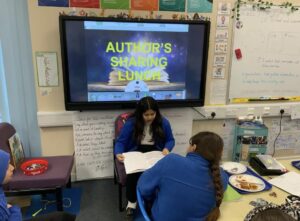
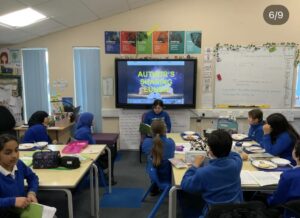
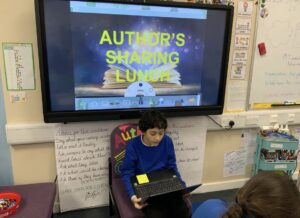
Our narratives ran the gamut from suspenseful tales to thrilling adventures, and even heartwarming stories about friendship. A few were autobiographical-drawing upon some emotional family memories, whilst others drew inspiration from our favourite films. We published our works in a range of formats that felt personal to us: some of us typed them up, others illustrated them, and a few even made books. The absolute cherry on top was an author’s sharing lunch with Mrs Parkar—what an absolute delight!
Mapping the World: Our Latest Adventure in Geography

This term, we’ve dived into a fascinating unit of work called “Mapping the World.” It’s been a brilliant journey exploring different types of maps, from topographical and thematic to street and political maps. Each format has its own unique features that tell us something special about our surroundings.

One of the highlights was learning how to read ordnance survey maps. These maps are like treasure maps, filled with symbols and details that help us navigate the great outdoors. We spent time deciphering common symbols, which sparked some lively discussions and plenty of “ah-ha!” moments. Who knew a simple triangle could represent a hill?

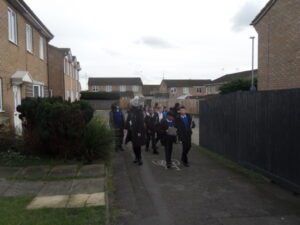
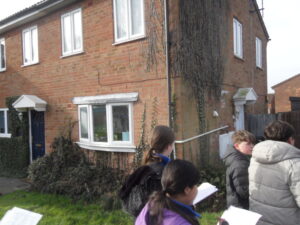
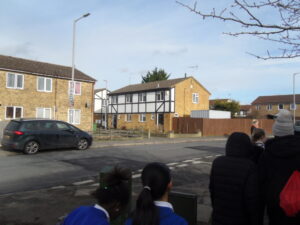
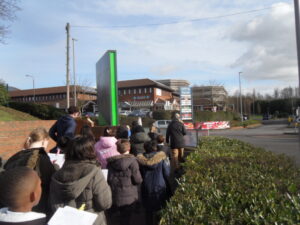
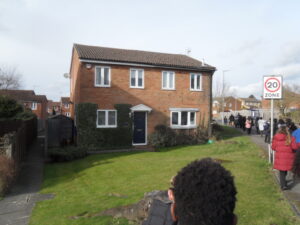
To wrap it all up, we took our learning out into the field. Our outdoor adventure involved investigating various house types in our local area, and it was eye-opening! We discovered how the architecture and style of homes reveal so much about the socio-economic geography around us. It was amazing to connect our classroom knowledge with the real world, reinforcing the idea that maps are not just tools but gateways to understanding our community. Overall, it’s been an engaging and enlightening unit that has certainly piqued our curiosity!
 

Maths

Ratio

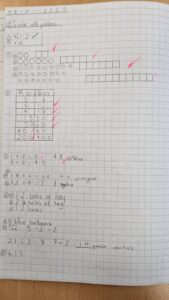
In Year 6 mathematics, the concept of ratios is introduced, providing pupils with essential skills for understanding relationships between quantities. The ratio symbol, represented by a colon ( : ), allows learners to express comparisons succinctly.

We have been looking at how ratios can be closely associated with fractions, as they both illustrate a relationship between two values. For instance, a ratio of 2:3 can be understood as two parts of one quantity to three parts of another. This foundational knowledge serves as a precursor to more complex applications, such as scale drawings, where pupils utilise scale factors to represent real-life objects accurately.

Understanding similar shapes is a pivotal aspect of ratio work; our students learn that corresponding sides of similar figures maintain consistent ratios. For example, if two similar shapes have a ratio of 1:2, any side of the first shape will measure half of the corresponding side on the second shape.

Pupils are also challenged with a variety of ratio problems, reinforcing their skills in practical contexts. Further, they tackle proportion problems, which often require them to determine unknown quantities based on given ratios. Through these activities, students develop a robust understanding of ratios, forming an essential component of their mathematical toolkit.

Algebra

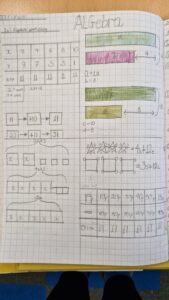
In Year 6, our pupils are introduced to the foundational concepts of algebra, which play a crucial role in their understanding of mathematical relationships and problem-solving skills. A key component of the curriculum is the use of function machines to represent and manipulate algebraic functions.

Students begin with 1-step function machines, where they learn to apply a simple operation to an input value, yielding an output. This concept then progresses to 2-step function machines, involving two operations that help pupils develop more complex reasoning skills.

Forming expressions represents another critical skill, as students learn to construct mathematical phrases using variables. Substitution is introduced in tandem, allowing learners to replace variables with specific values, thereby simplifying expressions for evaluation.

Pupils also engage with formulae, understanding how equations represent relationships between different quantities. This lays the foundation for forming equations, which they subsequently solve; initially focusing on 1-step equations before advancing to 2-step equations, enhancing their problem-solving capabilities.

Moreover, students are tasked with finding pairs of values that satisfy given conditions, and they learn to solve problems involving two unknowns. This holistic approach equips Year 6 pupils with the essential skills and confidence required for further study in mathematics.
 

Decimals

In Year 6, the curriculum places significant emphasis on understanding and manipulating decimals, an essential skill that underpins many mathematical concepts and real-life applications. Pupils are first introduced to rounding decimals, a fundamental ability that allows for simplification of numerical values, enhancing mental arithmetic skills and promoting estimation.

As students progress, they learn to add and subtract decimals, which aids in grasping the concept of a decimal’s place value. This understanding extends to multiplying decimals by 10, 100, and 1,000. Such operations require students to move the decimal point to the right, fostering a deeper comprehension of the relationship between whole numbers and decimals.

Conversely, when dividing decimals by these factors, pupils experience moving the decimal point to the left, solidifying their grasp of division in a practical context. Furthermore, multiplying and dividing decimals by integers allows for essential interactions with larger datasets, which is particularly relevant in problem-solving scenarios.

An emphasis on contextualised multiplication and division of decimals enables students to apply their knowledge to real-world problems, such as calculating finances or measuring distances. Mastering these skills ensures that pupils are well-equipped for the complexity of secondary education and daily life.

Science

As part of our ongoing curriculum, we are delving into the fascinating world of living organisms. Understanding how we can arrange organisms into groups forms the foundation of our studies in biology. The term “organism” refers to any living thing, which can be categorised broadly into three primary groups: plants, animals, and microorganisms.

Classification, the process of arranging organisms based on their physical characteristics, plays a vital role in scientific inquiry. Groups of organisms that can reproduce to create offspring are classified as the same species. This methodical approach allows scientists to name, study, and discuss organisms more precisely, aided significantly by advancements in microscopy.

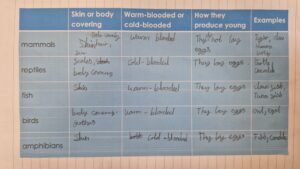
In exploring vertebrates—animals that possess a backbone—we can organise them into five distinct categories: mammals, fish, birds, reptiles, and amphibians. These categories further reveal that vertebrates can be classified as warm-blooded or cold-blooded, and they may reproduce through live birth or by laying eggs.

Conversely, invertebrates, which lack a backbone, include groups such as arthropods, molluscs, and annelids. For instance, arthropods can be subdivided into insects, arachnids, and crustaceans.

Plants, too, offer a rich field of study. They can be classified into flowering and non-flowering varieties, with flowers serving the vital purpose of attracting insects for pollination.

Lastly, we focus on microorganisms—tiny organisms often visible only under a microscope, such as bacteria and viruses. While some microorganisms can be harmful, others are beneficial, highlighting the need for us to understand how to protect ourselves from detrimental forms.


Empathy

Our value for this half term is empathy. It is vital that we explore the concept of empathy. Empathy, at its core, means seeing the world from another person’s perspective. This understanding of others’ feelings not only enriches our interactions but also plays a significant role in our emotional well-being.

Research has shown that cultivating empathy can lead to positive feelings, such as being helpful and understanding. When children learn to empathise, they are better equipped to build meaningful friendships. Establishing connections with others fosters a sense of worthiness, love, and care, while also promoting emotional stability and calmness in challenging situations.

To illustrate the power of empathy, we can look to historical figures like Mahatma Gandhi, whose commitment to understanding others’ plight was instrumental in his pursuits for justice and peace. His life exemplifies how empathy can drive meaningful change.

I encourage you to engage your children in conversations about empathy. Consider asking them how they can apply this vital skill in their daily lives. Together, let us cultivate a more empathetic community and support our children in understanding the world around them.


Uncategorized,Year 6 Blog

Off to a flying start in Year 6!

23rd October 2024Sabreen Parkar

In Year 6, we have hit the ground running! It has been a busy half term and the children have really taken all the new learning and transitions in their stride. They continue to work hard to embody our school value of Resilience by adapting to the demands and changes of Year 6 with ease and independence. They have already made so much progress and we are so proud of them all! Take a look at all the exciting things we have been getting up to…


English (Reading and Writing)

In reading this term we have been using various reading skills and techniques to enjoy and further our understanding of fiction and non-fiction texts.

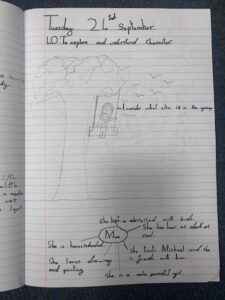
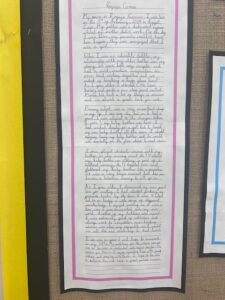
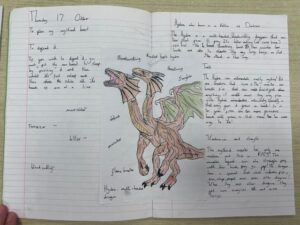
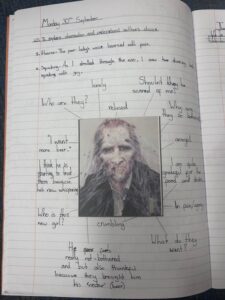
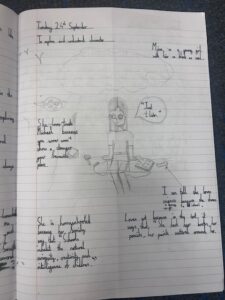
We studied Skellig by David Almond which is a story about children discovering a mysterious, fantastical being in a garage and how he begins to affect their thoughts and choices in life. Work completed included: character descriptions, inference, prediction and justification of opinions. Below are examples of some of the activities we completed as part of this unit:

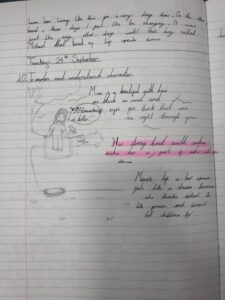
More recently, we have been studying a beautiful picture book called Mama Miti by Donna Ja Napoli. Through artful prose and beautiful illustrations, Donna Jo Napoli and Kadir Nelson tell the true story of Wangari Muta Maathai, known as “Mama Miti,” who in 1977 founded the Green Belt Movement, an African grassroots organisation that has empowered many people to mobilize and combat deforestation, soil erosion, and environmental degradation. Today, more than 30 million trees have been planted throughout Mama Miti’s native Kenya, and in 2004 she became the first African woman to win the Nobel Peace Prize.

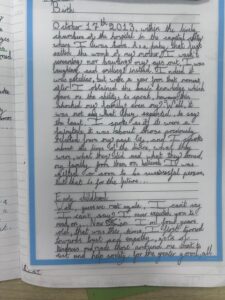
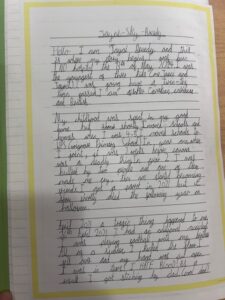
In English, we started the year with some autobiographical writing. This was a great way for our teachers to get to know us a little better. The anecdotes we shared were hilarious and really made our teachers laugh. We revised grammar skills from our Year 5 unit on biographical writing and learnt some new skills too, including: 1st person, past tense, chronological order, time conjunctions/use of cohesive devices and adverbials. Take a look at some of our autobiographies:


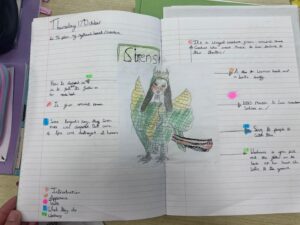
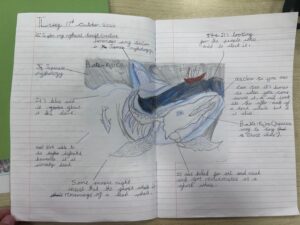
We have also been writing explanation texts linked to our Ancient Greek topic. We will be choosing a mythical beast and write a piece telling the reader what they are like in terms of appearance and character, what their strengths and weaknesses are and how they became what they are. Some of the beasts include: Medusa, The Hydra and The Minotaur. The grammar and punctuation skills that we have been learning to apply, include: parenthesis, causal conjunctions, cohesive devices, sentence signposts and topic sentences. Below are some of the examples of our mythical beasts that we have been writing about:


Maths

In maths this term we have been working on improving our number skills. At the beginning of the term we revisited place value. We worked on our understanding of number by recapping their Year 5 learning – exploring numbers up to 1,000,000. Understanding that place value columns follow consistent patterns – ones, tens, hundreds, then (one) thousands, ten thousands, hundred thousands, before reaching millions – was key. Having a strong understanding we then looked at values of digits in numbers. We used number lines to explore numbers to 10,000,000 using the unit of a million, making links to the familiar number lines to 10 and 10,000. They labeled partially filled number lines, identified points labelled on number lines and marked where a given number would lie on a number line. They learnt to compare numbers with the same number of digits, and with different numbers of digits, using their knowledge of place value columns. They presented numbers in a variety of forms and used these different representations to aid their understanding when comparing and ordering.
 
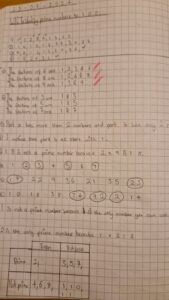
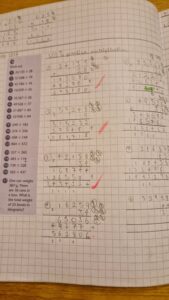
We have also revised addition, subtraction, multiplication and division. The children have been using the formal column method for numbers with the same and different numbers of digits. They have also been practising mental strategies with both large and small numbers, using their understanding of place value. They have also been applying these skills to problem solving, choosing which operations and methods to use based on the context of the problem and the types of numbers involved. We have been using our knowledge of the times tables and familiar rules of divisibilty to help us find common factors and apply them to division calculations. We have looked at and improved our understanding of prime, cubed and square numbers which in future can help the children to solve problems with area and volume. We have spent a lot of time on mastering a method to solve long multiplication and long division calculations. The children have found this a difficult concept to understand and will need to revisit this regularly to embed these strategies.

Science

Our science topic has been Light and the children have enjoyed finding out: Where it comes from, what colour it is, how shadows are formed, how we see objects and what the main components of the eye are. The children enjoyed making periscopes, investigating the formation of shadows and using a prism to look at the colours of the spectrum.

Ancient Greek day

On Thursday 10th October year 6 celebrated all things Ancient Greece when we were visited by Adventures Into, who put on some fabulous Ancient Greek infused activities for the children to take part in.

The day began with a breakfast of date, pitta bread, feta cheese and olive that would have been eaten back in the day. This was then washed down with a cup of wine. WHAT I hear you say. It’s ok, wine was substituted with grape flavour squash. Some children discovered new flavours that they liked whilst others tasted things that they will never taste again..

We then split into our classes and took part in three different activities:

Ancient Greek orienteering

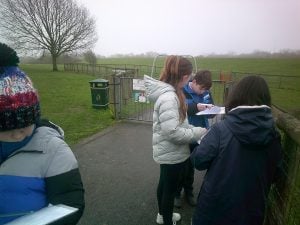
Groups of children looked for clues set up all over the school field which linked to a given letter of the Greek alphabet. The rain didn’t hold them back and the clues were mopped up excitedly and successfully with many facts being learnt in the process.

Greek theatre

The children learnt about parts of the theatre in Ancient Greek times, who took part in the plays, some of the characters depicted and the different types of play that were written and performed-tragedies and comedies being the main examples. What the children enjoyed most was being able to create their own mythical beast out of clay and make up a back story to who it was and why it had turned into the creature it was. We had many weird and wonderful looking creations that would have looked great in an Ancient Greek mythical play.

Warfare

The children learnt about the different weapons and tactics the Ancient Greeks used in battle. Siege towers, catapults and swords were mentioned and then out came the bows and arrows. The children had the job of firing at a target with Polythemus the Cyclops on it and getting him right in his one good eye or hitting the back of the welly boot exactly where the Achilles would be. This was followed by a “battle to the death” between deadly foes using all of their fighting skills and guile to get one over on the other. Dodge ball with bows and sponge arrows-vicious or what?

The children (and staff) had a wonderful day and it complemented the work we are doing in class so well.


Black History Month

We are celebrating this important part of our history by learning about one modern black icon and one from over 100 years ago. Baroness Floella Benjamin a Trinidadian-British actress, author, presenter and politician and Walter Tull,, an English professional footballer and 1st World War army officer.

This year we have teamed up with year 2 and each year 6 class has split in half. One half has joined the children down in year 2 and the other half has welcomed year 2 children up to year 6. It has been lovely seeing our year 6 children working patiently and helpfully with their year 2 buddies and taking part in art and drama activities. We have also looked at the impact of Walter Tull and other black footballers from the past on the modern England football team.

Outdoor learning 

This year we have been provided with an allotment space to grow vegetables. The children will care for and harvest what they have chosen to grow and these vegetables will be passed to the kitchen and used in their school dinners. Unfortunately, due to the weather conditions we have not managed to get outside and plant our broad beans. However, we have managed to prep the plot so the beans are ready to be planted. We are all looking forward to getting outside and planting the beans.
Year 6 Blog

Spring Has Sprung in Year 6!

31st January 2024Sabreen Parkar

Thank you for taking the time to make your way to our little space on the internet. It is hard to believe that we are already in the Spring term and it is even more surprising how quickly January has appeared and disappeared! The children ended 2023 with a hip, skip and a hop and they have brought the same energy into 2024.

We are so proud of how hard they worked last term and the progress they have made already. They have each, individually, taken Year 6 in their stride and have continued to show us what they are made of with their efforts and determination.

Perhaps the most exciting thing that has happened this year so far, is the commencing of our SATs Boosters. We were blown away by the response from parents, and we are so grateful for your support. Thank you for your patience as we got them up and running- it wasn’t an easy feat! However, the children have been amazing and so enthusiastic in their sessions, so the time and energy that went into organising them was well worth it.

We hope you enjoy reading about all the wonderful things we have been getting up to!

Mrs Parkar, Mr Omer and Miss Bloomfield 🙂

ENGLISH: Writing

This term, we have been learning how to write to advise, in the form of an “agony aunt/uncle” style letter. Writing to advise has been a totally new genre for the children, and yet they have not ceased to amaze us with their fantastic writing.

We focused heavily on audience and purpose and how this impacts our language, grammar, punctuation and vocabulary choices. Take a look at some of the words the children have learnt how to read, write and apply:

Contend Communicate
Navigate Advisable
Understandably Despite
Anxious Established/establish
Ensuring/ensure Willing
Receiving/receive Harmless
Adjust Reluctant
Undoubtedly Ought
Condition Engage
Familiar Consider
Regarding Informing
Outgrow Refrain
Relate Apparent
Acceptable Commendable
Beneficial Essential
Deemed Foremost

Just WOW! The children have really exercised the value of empathy in this unit, as they have had to read “problems” written to them and had to discuss, brainstorm and identify solutions that were sensitive and mindful of the feelings inferred from the letters. Below are some examples of the short bursts of writing they have completed in this unit. The first being: Writing to advise on what to take on a camping trip and the second being: Writing to advise a new child on what to bring to school in their packed lunch. Their final piece was writing to advise a child who was worried about their friend.

The children have been learning new grammar skills as well as constantly retrieving those that have been taught previously. Below is our success criteria for this unit; including the tools of advisory writing, and we are confident that children are able to discuss and apply these skills in their writing.

Have a look at some of our final pieces… and this was just the first draft!
ENGLISH: Reading

At the start of the term, year 6 completed a short unit on the poem Jabberwocky by Lewis Carrol. In lessons, we spent time:

  • Reading, listening to and familiarising ourselves with the poem-listening to the wonderful Benedict Cumberbatch reading the poem was a highlight for the teachers.
  • Discussing poetic features and Carrol’s use of nonsense words and his creation of portmanteaus (go on look it up and find out what this is or even better ask your children).
  • Creating their own versions of the poem making up their own nonsense words and following the structure of the original

After this, we began a unit (which we are continuing presently) on Stormbreaker by Anthony Horowitz. This is really handy, as our next unit of writing will be based on the same text.

Fourteen-year-old Alex is forcibly recruited into MI6. Armed with secret gadgets, he is sent to investigate Herod Sayle, a man who is offering state-of-the-art Stormbreaker computers to every school in the country.

In our lessons we are enjoying reading the book and using our reading skills to further understand characterisation, higher order vocabulary and structure.

MATHS: Ratio

This term in maths year 6 have been learning about ratio. We have learned all about multiplicative and additive relationships.
We have looked at the connection between simplifying ratio and simplifying fractions, they both involve dividing and common factors. We learnt that ratio compares one item with another and fractions compare each part with a whole.
 We used this new knowledge and applied it to scale drawings. We used multiplicative relationships and scale factors to enlarge and reduce shapes. We also applied our learning to solving ratio problems.

SCIENCE: Classification

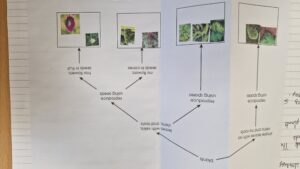
Before moving onto Evolution and Inheritance, we have been working hard to complete our unit on Classification. The children are finding out about how scientists identify and organise all creatures into specific groups depending on certain characteristics.

They are using decision trees to help them identify and classify certain creatures and are developing their understanding of the vocabulary of classification eg vertebrates, invertebrates, organism, micro-organism, genus, species to name but a few.

Within this topic, there will be the opportunity for some field-work where we will be using the outside nature area to investigate some creepy crawlies. So Year 6 (and Mrs Parkar) WATCH OUT!

Below is a knowledge organiser that depicts all the things we have been covering, including some of the key vocabulary:

Whipsnade Zoo
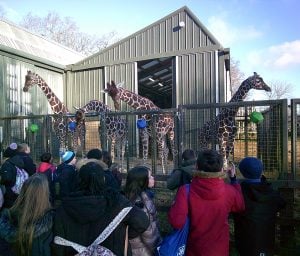
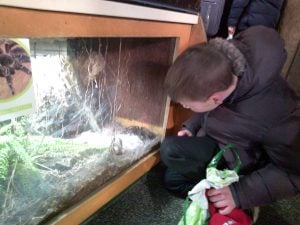
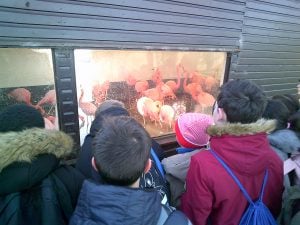
To kick start our upcoming unit on Evolution and Inheritance, we were fortunate enough to visit Whipsnade Zoo, where we attended a workshop to learn all about natural selection, inheritance and the evolution of certain species. The children thoroughly enjoyed their visit and were even able to go for a lovely, quiet Winter walk around the zoo; spotting lots of animals!

GEOGRAPHY: Mapping the world

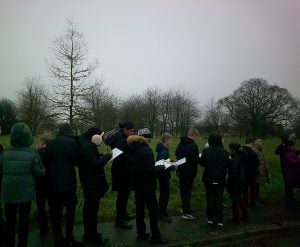
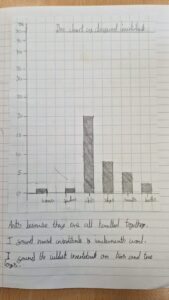
We started our unit just before Christmas, and have spent this half term continuing our learning about maps- specifically ordnance survey maps. We then planned and carried out some fieldwork in the local area. We focused on two enquiry questions: “How green is our local area?” and “How well looked after is our local area?” We focused on a range of indicators, including: litter, traffic, buildings, recreation, green spaces, up keep and garden types (to list a few). We then had a go at using Purple Mash to input this data in a spreadsheet in order to generate a range of graphs to present our findings.


Front Page News,Year 6 Blog

Year 6 Autumn Term

30th November 2023Sabreen Parkar

In Year 6, we have hit the ground running! It has been a busy two months and the children have really taken all the new learning and transitions in their stride. They continue to show resilience and independence and we are so proud of all the progress they have already made. Take a look at all of the exciting things we have been getting up to…

Reading and Writing

In reading this term we have been using various reading skills and techniques to enjoy and further our  understanding of fiction and non-fiction texts.

We studied Skellig by David Almond which is a story about children discovering a mysterious, fantastical being in a garage and how he begins to affect their thoughts and choices in life. Work completed included: character descriptions, inference, prediction and justification of opinions.

An example of a Role on the Wall we completed as part of our character study

Our non-fiction text was all about the Olympic Games- which linked nicely with our History topic on Ancient Greece. We learnt about differences between fiction and non-fiction texts, how to summarise parts of a text and the features used in terms of layout and design on the page e.g. sub-heading, caption, highlighting text.

Our English (writing) lessons have covered poetry, explanation text, diary writing and suspense stories.

In poetry we revised poetic techniques (alliteration, simile, imagery ) and asked the children to write a poem using a given structure.

Our explanation text was linked to our Ancient Greek topic and the children had to choose a mythical Ancient Greek beast and write a piece telling the reader what they are like in terms of appearance and character, what their strengths and weaknesses are and how they became what they are. Some of the beasts chosen were: Medusa, The Hydra and The Minotaur.

Also linked to the Ancient Greek topic, was our diary recount writing. The children were asked to create their own hybrid mythical beast and write a diary account as Greek hero Heracles, after battling their beast in his “13th Labor”.. The children learnt about the impersonal style of writing used in a diary recount and the text features which make a diary interesting to read.

We are currently coming towards the end of our unit on narrative writing. We have been revisiting suspense writing (that we did in year 5) and have been building on our grammatical and literary skills by learning to write with suspense; following a chasing/hiding plot. We have been learning how to use new punctuation, including: colons, semi-colons and dashes as well as learning how to create complex sentences involving adverbial and prepositional phrases.

Maths

This term we have been learning all about number addition and subtraction by integers, prime numbers, rules of divisibility, short and long division,  multiplication of 4 digit numbers by 2 digit numbers and problem solving.

We have also started to look at fractions: Equivalents and simplifying, comparing and ordering fractions, adding and subtracting simple fractions, add and subtract mixed number fractions.

Science

Our science topic has been Light and the children have enjoyed finding out: Where it comes from, What colour it is,  How  shadows are formed, How we see objects and what  the main components of the eye are. The children enjoyed making periscopes, investigating the formation of shadows and using a prism to look at the colours of the spectrum.

Art and History

Our topic this half term has been all about The Ancient Greeks. We kick started this unit with an exciting Ancient Greek day. We have been learning all about Ancient Greek life, their governments, their influence and their impact on the modern day. In line with this, we have been studying Greek art. We have investigated the three different periods covered in this time: The Archaic period; The Classical period and the Hellenistic period. We talked in detail about the differences between the eras, our likes and dislikes and what influenced the changes during this time.

The Archaic Period
The Classical Period
The Hellenistic Period

We did an art appreciation lesson about Phidias, the Greek sculptor, and evaluated his work. We have improved our drawing skills and focused on figurative drawing using sketches to plan and improve  our final drawings, working on using correct proportions by sectioning the body and adding detail to finish the drawings off.

We have investigated Greek pottery and designed our own Greek pots inspired by our life story, the labours of Heracles or the Olympic games.

What’s coming up?

English: Writing

Our next unit of writing will be to write to advise. Children will interrogate an “Agony Aunt” style model text and identify the key grammatical skills required to successfully write to advise, including:

  • Revision modal verbs
  • Revise adverbs of possibility
  • Introduce the subjunctive form
  • Introduce colons to introduce a list
  • Revise paragraphing


This will then be followed by a unit of poetry based on a poem called “War Game” by Michael Foreman. The children will be revising key grammatical skills and poetic devices including:

  • Figurative language including simile and metaphor
  • Revising punctuation for clarity
  • Precise vocabulary and using shades of meaning (synonyms and antonyms)


Geography: Mapping the world

The unit begins by exploring what maps can tell us about the world. Pupils will learn about the different types of maps, such as physical, political, topographic, and thematic maps. They will also learn about the different purposes of maps. As pupils explore the maps, they will discover that they provide lots of information about the world around us.

Science: Classification

The unit includes a variety of investigations that enable pupils to learn how and why living things are classified into broad groups based on similarities and differences, and according to common observable characteristics. Pupils will learn how to use a key to classify species. They will research a broad range of animals and plants and come to understand why they are placed in one group and not another. As the unit progresses, pupils will learn about microorganisms and how they can be both helpful and harmful. This will give pupils the opportunity to realise that microscopic organisms can also be classified.

Thank you so much for taking the time to read our first blog, we hope you enjoyed it and are looking forward to the new term! We hope you have a wonderful holiday and happy new year with your loved ones!

Mrs Parkar, Mr Omer and Miss Bloomfield

Front Page News,Year 6 Blog

Year 5- Happy Holidays!

9th December 2022Sabreen Parkar

Wow! We cannot quite believe how quickly this term has gone by! We have been blown away by so many of the children in our classes- the quality of work has been outstanding!  Below is a snapshot of what we have been up to over the last few weeks.

Music

This term, we have been learning the iconic song ‘Livin’ on a prayer’ by Bon Jovi. We started by learning the lyrics and rhythms and then moved onto playing some key notes on the glockenspiels to accompany the song.  Look out for some of our performances on Twitter, coming soon!

Science

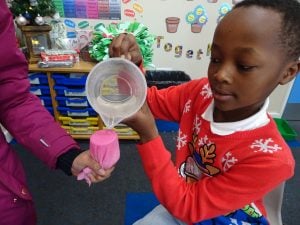
This term we started our new topic: “Properties and changes of materials.” We revised some of the key vocabulary and content that we learnt last year and are now building on these key concepts. We have carried out some exciting investigations too! We started by conducting a test on the properties of a range of materials e.g. the flexibility, permeability, hardness, transparency and magnetism of objects. We will soon be moving onto carrying out comparative investigations, like testing the best thermal conductor and insulator. Do you recognise these words? Can you think of everyday objects that are thermal conductors/insulators?


Design and Technology  

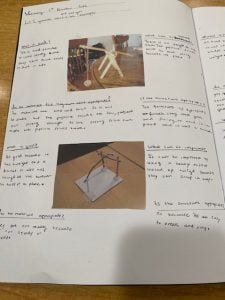
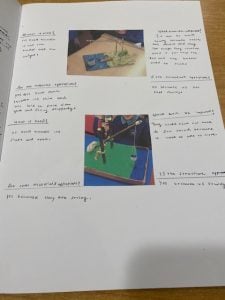
As part of the ancient Egypt topic work, the children in Year 5 have learnt the importance of a Shaduf and the river Nile. In DT this term, they will be creating a shaduf by applying their knowledge of levers from science. By working as a group, they have begun planning their ideas- trying to select the best materials and resources to create their prototypes. Over the next few days, they will be bringing their ideas to life and creating their final product, ready to put it to the ultimate test. Will their shaduf be strong enough to carry the water from low to high ground? Take a look at some of the initial research they did.


Feeling Festive!

A huge thank you to all the parents and carers who came along to our Christmas craft morning- we had so much fun creating wreaths, reindeer hot chocolate and snowmen bookmarks!

We are absolutely loving Bookvent and have enjoyed listening to the children read out their favourite chapter of their favourite book to the whole class.

We are very much looking forward to walking up to Queen Elizabeth School on Wednesday 14th December to watch their Christmas Panto: Robin Hood and His Merry Men. Please do remember to sign and return the permission slip before Monday.

We would like to take this opportunity to say happy holidays and we hope that you all have a restful break ready to return on Wednesday 3rd January 2023.

Miss Islam, Mrs Parkar and Miss Khan


Year 5 Blog
Contact
Twyford Drive, Luton,
Bedfordshire, LU2 9TB

01582 616101

[email protected]

SWGfL Report Harmful Content
School website powered by realsmart brand logo